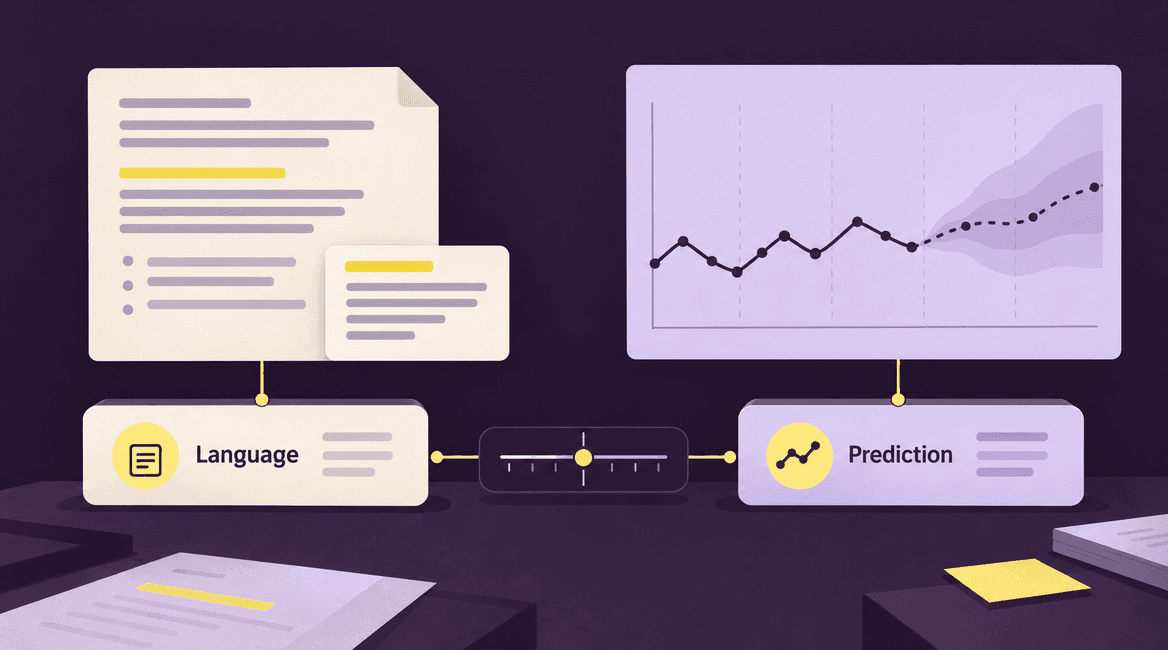

RAG vs. Fine-Tuning: When to Use Each for Your AI App
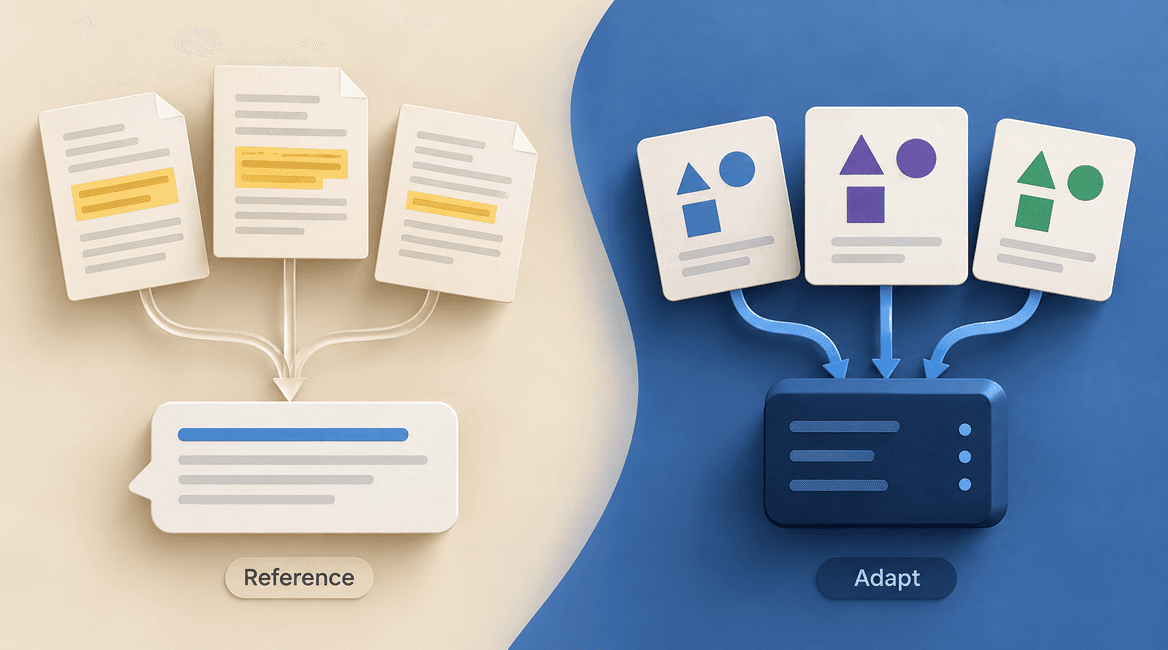
RAG and fine-tuning solve different problems, even though both can improve an AI application. RAG retrieves information and supplies it when a model answers. Fine-tuning updates an existing model using training examples so its behavior better fits a task.
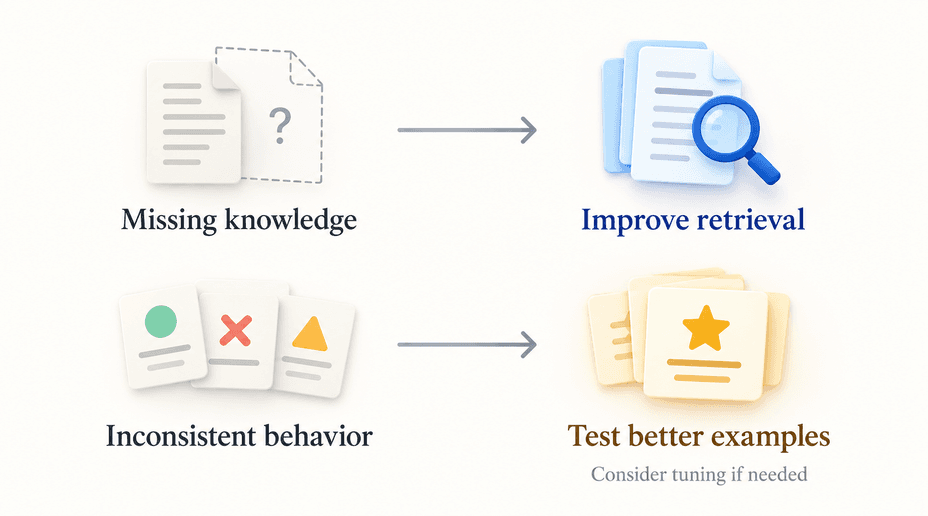
If your assistant quotes last year's policy, it may need better access to current information. If it has the right policy but repeatedly writes an answer in the wrong format or applies a specialized classification rule inconsistently, the problem may be task behavior. Neither diagnosis automatically proves which implementation you need.
This guide uses a hypothetical business-support assistant to compare the approaches, explain where they overlap, and show how to test the decision before funding a larger build.
First ask whether the model saw the right evidence. Then ask whether it used that evidence correctly.

What RAG and fine-tuning change
RAG supplies information during a request
Retrieval-augmented generation adds a search step before the model produces an answer. Your application finds relevant material, includes it in the request, and asks the model to use it. The source might be a help center, product manual, policy collection, or other permitted content.
The model's parameters do not change during this lookup. Updating the source collection can change what information is available to future requests, provided indexing, caching, and removal processes work correctly. Retrieval is therefore a useful candidate for changing business knowledge, but freshness is an operational responsibility rather than an automatic property.
Fine-tuning changes a model through training
Fine-tuning starts with an existing model and adapts it using examples. For a language-model application, examples might demonstrate the required response structure, labeling rules, terminology, or task execution. The training method and available controls depend on the model and provider.
Fine-tuning is not the same as uploading a document folder to a searchable knowledge base. It can affect what a model learns, but it is generally a poor default mechanism for maintaining exact, frequently changing facts with traceable sources. It also does not guarantee perfect compliance with a rule.
Google's guide to using business data with language models describes prompting, retrieval, and tuning as distinct options that can be combined. The practical question is which part of your workflow needs improvement.
Neither technique replaces ordinary application logic
Use a direct database or service lookup when a question requires an exact current value such as an account balance or order status. A language model may explain that result, but it should not estimate the value from a policy document. Enforce permissions, calculations, and state transitions in the application.
Before choosing either technique, try a clear task instruction and a few representative examples. A stable output schema or a small prompt improvement may solve the problem. Establish this simpler baseline so you know whether a more complex approach earns its ongoing cost.
Choose based on the failure you can observe
The answer needs current, attributable information
Our support assistant answers questions about service policies. Its fees, coverage areas, and exceptions change over time. It needs the relevant current document and a way to point the reader back to it. A retrieval-based design is a reasonable starting point.
The implementation must select the correct version, handle contradictory sources, filter by audience, and remove retired content. If the search retrieves the wrong policy, fine-tuning the answer style will not fix the missing evidence. Review retrieval logs and expected source matches before blaming the model.
The task needs consistent specialized behavior
Now imagine the same business labels incoming requests using a stable internal taxonomy. The model receives all necessary text but repeatedly confuses two categories despite clear definitions and examples. Fine-tuning may be worth evaluating if you have enough representative, consistently labeled examples and a meaningful held-out test set.
First inspect disagreement among human reviewers. If experienced staff cannot agree on the correct label, clarify the taxonomy before training. A model trained on contradictory examples may reproduce the disagreement with greater confidence rather than resolve it.
Both evidence and behavior matter
A support assistant might need current policy retrieval and a particular response structure: brief answer, applicable exception, next action, and source. Start by checking whether prompting and output controls achieve that structure. If behavior still falls short on a stable evaluation, a tuned model could consume the retrieved evidence.
The combination adds two systems to maintain. You must evaluate retrieval changes and model adaptation independently enough to locate regressions. Avoid adding both at once without a baseline; otherwise, an improvement or failure becomes difficult to explain.
Run a comparison that teaches you something
Build a test set around real decisions
Collect representative questions and define what an acceptable answer must contain, which sources support it, and when it should decline or ask for clarification. Include outdated policies, ambiguous requests, conflicting documents, and questions outside the approved scope. Remove sensitive details where they are unnecessary for evaluation.
Keep evaluation examples separate from training examples. Do not repeatedly tune against the final test set and then report that same set as independent evidence. Google's guidance on dataset separation explains why training, validation, and test data serve different purposes.
Compare sensible candidates on the same tasks
- Baseline: the existing model with clear instructions and a small set of examples.
- Retrieval candidate: the same task with approved source passages supplied at request time.
- Tuned candidate: an adapted model for the demonstrated behavior problem, when training data justifies it.
- Combined candidate: retrieval plus adaptation, only if the separate tests reveal a reason to combine them.
Do not compare a tuned model with carefully curated inputs against a baseline deprived of information it could reasonably receive. Hold the task and permitted evidence as consistent as the approaches allow, document any differences, and include the end-to-end user experience.
Score more than answer fluency
Review factual correctness, source support, completeness, adherence to the task, appropriate abstention, and privacy boundaries. Also measure latency, request cost, and how much human correction remains. A beautifully formatted answer that omits the exception can be worse than a less polished but accurate one.
For retrieval, separately check whether the right source was found and whether the final answer followed it. For fine-tuning, check whether improvements generalize beyond familiar examples. Keep failure categories visible instead of hiding every outcome inside one average score.
Before you launch: a practical checklist
- The problem is classified as missing evidence, inconsistent behavior, or both.
- A simpler prompt or deterministic lookup has been tested where appropriate.
- Source ownership, permissions, versioning, and deletion are defined for retrieval.
- Training examples have consistent labels and permission for the intended use.
- Training, validation, and final evaluation examples are separated appropriately.
- Candidates are compared on representative tasks with documented input differences.
- The evaluation checks correctness, source support, cost, latency, and human corrections.
- The team knows how to update, roll back, and re-evaluate the chosen approach.
Compare maintenance as well as setup
A retrieval system needs content ingestion, search configuration, access filtering, source refresh, and monitoring. Changes to document structure can affect search quality. If a policy disappears from the source website but remains in an index or cached answer, the assistant can still repeat it.
A tuned model needs dataset curation, training runs, evaluation, version management, and a plan for changed task definitions or base-model availability. New examples do not improve a deployed model until they pass through an actual update process. Preserve the prior version so a regression has a recovery path.
Neither approach is universally cheaper. Retrieval adds context and search operations; tuning adds training and maintenance and may change inference economics. Compare total operating cost using your workload and provider configuration rather than assuming that a smaller prompt guarantees a lower total bill.
A practical decision for the example assistant
For changing service policies, begin with a small approved source collection and retrieval tests. Keep exact account facts in authenticated service lookups. Use a clear prompt to produce the desired answer structure, and measure whether users receive correct answers with useful sources.
Consider fine-tuning only after collecting evidence of a persistent behavior problem that better instructions, examples, and application validation do not adequately solve. This sequence is a testable plan, not a rule that every AI product must eventually progress to a tuned model.
For the larger choice between existing models and task-specific machine learning, see whether your app needs a custom AI model. For implementation details around permissions and retries, see our AI integration guide.
FAQs
Does RAG eliminate hallucinations?
No. Retrieval can supply relevant evidence, but the search may return the wrong passages and the model may misinterpret them. Check both stages, require appropriate fallback behavior, and review high-impact answers with a person or deterministic rule.
Can fine-tuning teach the model our business knowledge?
It can adapt a model using domain examples, but that is different from maintaining a current, inspectable source of truth. For frequently changing policies or facts that need citations, retrieval or a direct data lookup is usually the better first experiment.
How much training data is enough?
There is no universal number. It depends on task complexity, example quality, model capability, and coverage of important cases. Start with a data audit and learning experiments. Adding more duplicated or inconsistent examples is not the same as adding useful coverage.
Can we use RAG and fine-tuning together?
Yes. A tuned model can receive retrieved context. Use that combination when separate evaluations show that fresh evidence and adapted behavior are both needed, and budget for maintaining both systems. Discuss your AI workflow with DevConex to turn the decision into a scoped experiment.