
Does Your App Need a Custom AI Model—or Is an Existing API Enough?
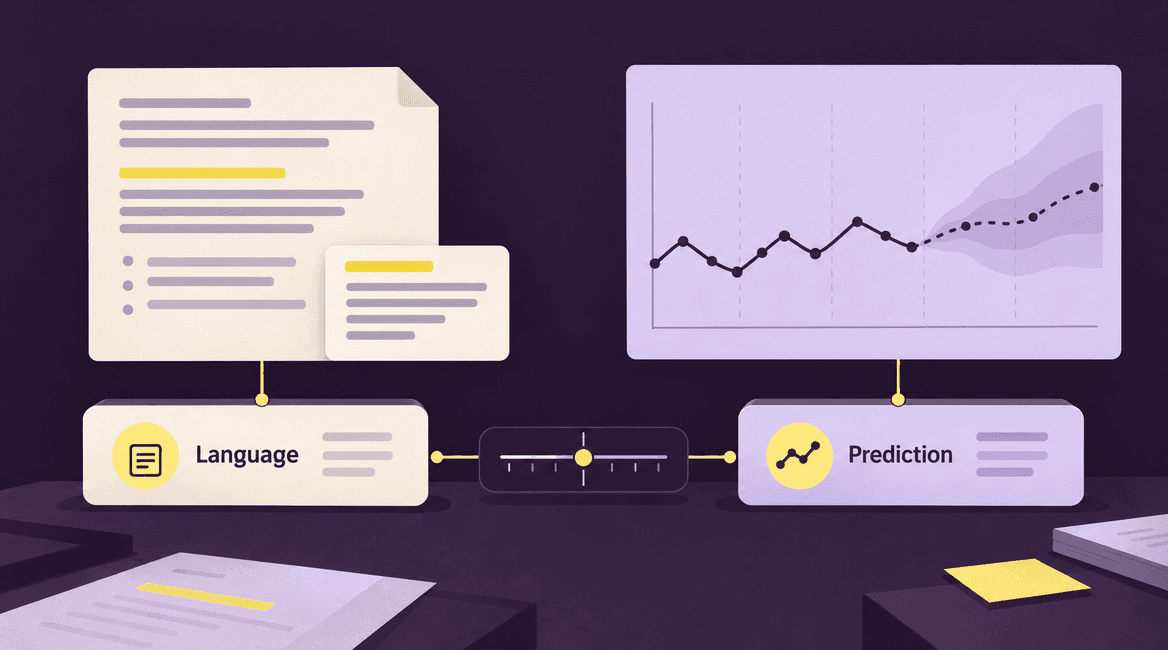
Your app may need AI without needing a model built from scratch. Summarizing a document, forecasting demand, and detecting defects in a production image are different problems. The right starting point depends on the output you need, the evidence available, and what a wrong result would cost.
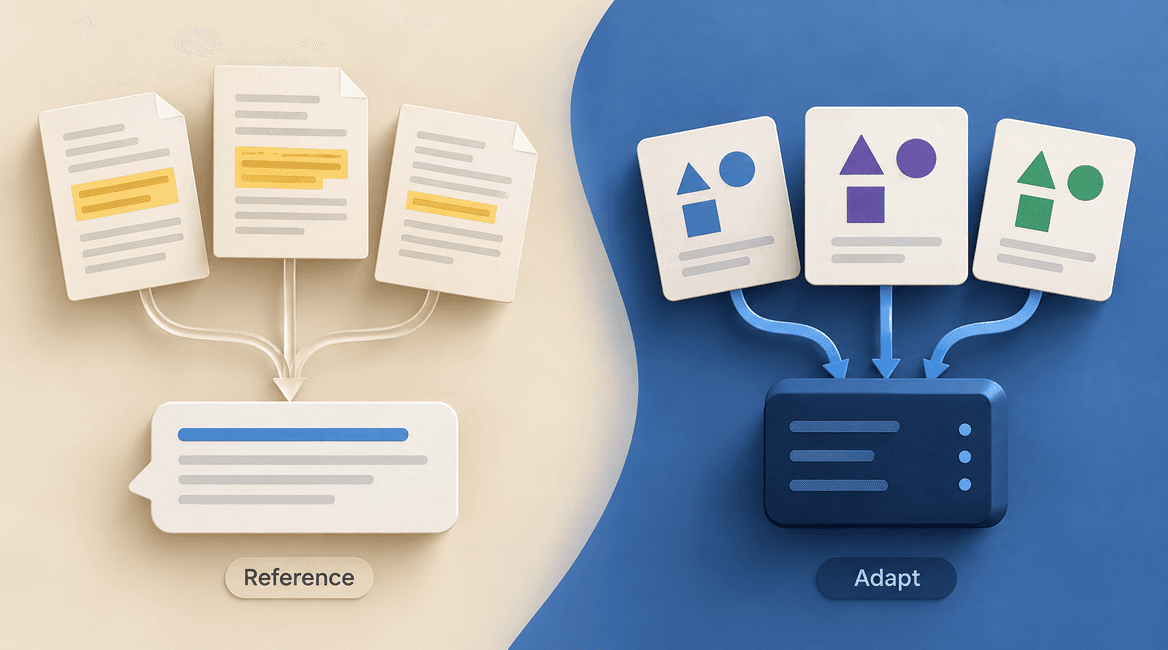
An existing language model is often a useful starting point for language tasks. A task-specific predictive model may fit a forecasting or classification problem better. Fine-tuning sits between those ideas: it adapts an existing model rather than creating a foundation model from nothing.
This guide helps founders and product teams decide what to investigate before paying for custom AI development. The examples are hypothetical decision scenarios, not claims of measured client results.
The case for a custom model is a measurable improvement on your task, supported by data you can actually use.

First separate the model from the way you access it
An API is a delivery method
The phrase “custom AI model versus API” mixes two decisions. An API is how software calls a service. You can access an off-the-shelf model, a fine-tuned model, or your own deployed model through an API. You can also run some existing models on infrastructure you control.
The useful questions are: which model can perform the task, does it need adaptation, where should it run, and who will operate it? Buying access to an existing model does not prevent you from building a distinctive application around your own workflow, data, interface, and evaluation process.
Existing foundation models are already machine learning
There is no dividing line between “real machine learning” and using a language-model API. Both involve learned models. The distinction is whether you are applying an existing general-purpose capability, adapting it, or training a task-specific model using your own examples.
That distinction matters for staffing and cost. Integrating a model requires application engineering and quality evaluation. Training and operating a predictive system also requires data preparation, experiment design, deployment, and monitoring of how performance changes over time.
Match the approach to the job
Start with an existing model for common language capabilities
Consider an existing model when the main task is summarization, drafting, extraction, translation, or interpreting natural-language requests. Test representative examples rather than assuming the model can handle every document format or domain. Pair it with explicit validation and human review where needed.
A hypothetical application that extracts invoice fields could start with an existing document or language model, then validate totals, dates, and required fields in code. The product still needs file processing, access control, a correction interface, and a record of what was accepted. The model call is one component of that workflow.
Add retrieval when the missing piece is your information
If a model answers well but lacks your current manuals or policies, supply relevant information during the request. This may involve search over approved documents or a direct call to an authorized system. You do not necessarily need to alter model weights to give an assistant access to business knowledge.
For example, a website assistant can retrieve the current delivery policy and link to it. It should not rely on remembered policy facts or guessed order status. Our website chatbot guide explains how to build that bounded first version.
Consider fine-tuning for a demonstrated adaptation problem
Fine-tuning may be worth testing when a stable, specialized task repeatedly falls short despite good instructions, representative examples, and reasonable output controls. Potential goals include applying a particular taxonomy or producing a consistent domain-specific response pattern.
You need examples that demonstrate the desired behavior, a meaningful evaluation set, and a reason to expect the improvement will matter commercially. Fine-tuning is not a guarantee of accuracy, privacy, or lower cost. Compare it with the baseline on your workload. See RAG versus fine-tuning for how to diagnose that narrower choice.
Use task-specific predictive ML when the problem calls for it
A demand forecast needs a prediction for a future period based on historical signals available at prediction time. A general chatbot producing plausible numbers is not a substitute for a forecasting evaluation. Start with a simple baseline, such as recent demand or the corresponding seasonal period, and test candidate statistical or machine-learning models against it.
Other candidates include ranking, anomaly detection, specialized image classification, and predicting a clearly defined business outcome. “Custom” does not have to mean a giant neural network. A smaller trained model or even a well-designed rule may be sufficient. Google's Rules of Machine Learning emphasizes useful metrics, simple baselines, and a dependable pipeline before unnecessary complexity.
Treat foundation-model pretraining as a separate investment
Training a general-purpose foundation model from scratch is substantially different from adapting a model or training a small predictor. It requires a credible data strategy, compute, specialized expertise, evaluation, and long-term operation. A normal business application should not assume this is the destination of a successful AI roadmap.
There can be specialized reasons to investigate it, but require a written explanation of why existing models, adaptation, and narrower approaches cannot meet the objective. Owning a training run is not itself a customer benefit.
Audit the data before approving model development
Define what one example represents
For a prediction task, identify the input, the target outcome, and when the prediction would be made. A demand forecast might use information known before the next sales period. Including the period's final sales in an input would leak the answer into training and make an offline result misleading.
Check whether outcomes are recorded consistently, whether missing values have meaning, and whether the examples represent future users and conditions. Confirm that the data can be used for the intended purpose. A large database is not automatically a usable training dataset.
Separate development data from an honest test
Choose a split that matches the real deployment. Forecasting often requires evaluating on later time periods. Systems with many records from the same customer or document may need grouped separation to avoid near-duplicate examples on both sides. A random row split can make performance look better than it will be on unfamiliar cases.
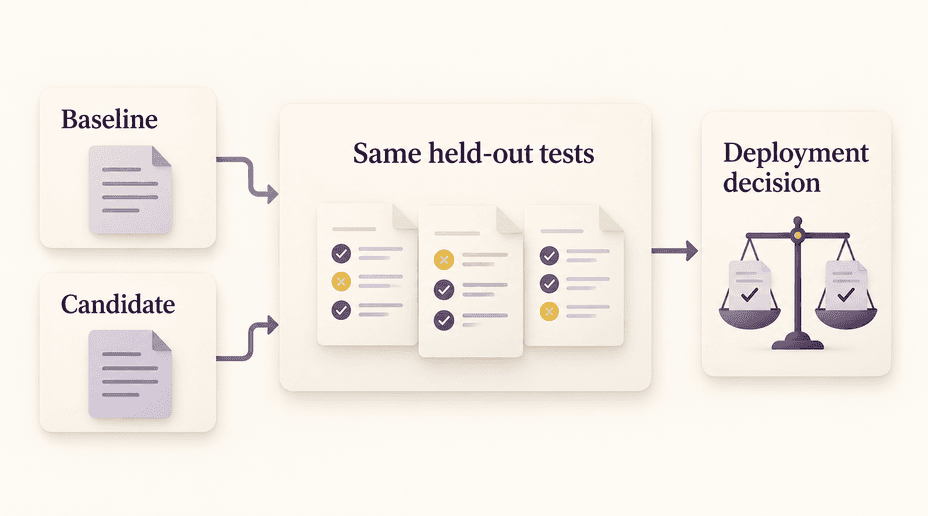
Keep the final evaluation independent of the repeated decisions used to improve the model. Document who labels ambiguous examples and how disagreements are resolved. If you cannot explain what the correct result is, you cannot credibly claim the model has learned it.
Plan for inputs that change
A predictor trained on one product mix may struggle after a new category launches. A document model may fail when suppliers change their layouts. Define what your system does when an input is unfamiliar: request review, use a fallback, or decline to make a prediction.
Monitoring needs more than an uptime chart. Track input changes, missing data, delayed real-world outcomes, and task quality when labels become available. Assign someone to investigate degradation and decide whether a data fix, rule change, retraining run, or model replacement is appropriate.
Before you launch: a practical checklist
- The task has a defined output and a business measure of success.
- An existing model, simple rule, or statistical baseline has been evaluated.
- The reason for adaptation or custom training is tied to observed failures.
- The available data represents the intended users and can be used for this purpose.
- Evaluation avoids answer leakage and inappropriate overlap between datasets.
- The application has a fallback for unfamiliar inputs and unavailable models.
- Training, inference, review, infrastructure, and maintenance costs are included.
- A named owner can monitor quality, roll back versions, and manage future updates.
Compare total cost and operating responsibility
A hosted model may charge for usage and reduce the amount of infrastructure your team operates. You still own integration, testing, data handling, and the customer experience. Self-hosting an existing model changes infrastructure and control; it does not automatically improve the model's fitness for your task.
A custom predictor may be inexpensive per prediction but costly to maintain if its data pipeline is fragile or labels require extensive manual work. Include data cleaning, annotation, experiments, deployment, monitoring, human review, and future updates in the estimate. Compare cost per useful outcome rather than only cost per model call.
Also consider latency, offline operation, deployment constraints, and expected volume. A device that must work without connectivity may need an on-device approach even if a hosted model scores better on a laboratory test. Document the tradeoff instead of hiding it behind a single “best model” ranking.
Fund a decision experiment first
A useful discovery deliverable is a short, reproducible comparison. Define the workflow and success criteria, assemble a permitted evaluation set, implement the simplest credible baseline, and test one or two justified candidates. Record failure examples and cost assumptions alongside the scores.
The result may recommend an existing model, more data work, a narrow custom predictor, or no AI feature at all. That is useful progress. It prevents a large development commitment from being based on an impressive demo with unrepresentative inputs.
FAQs
Does using an existing API make our product less custom?
No. The workflow, permissions, business logic, data connections, user experience, and quality controls can all be specific to your business. Customers usually care whether the product solves their problem reliably, not whether you trained every component yourself.
Will a custom model always be more accurate?
No. It can outperform an existing option on a well-defined task with appropriate data and engineering, but it can also underperform. Require an independent evaluation on representative cases, including important exceptions and unfamiliar inputs.
Should we collect more data before starting?
First audit what you have and test a baseline. You may discover that a small number of missing labels, clearer outcome definitions, or better coverage matters more than raw dataset size. Collect new data to answer a specific performance question.
What should we ask a development partner to prove?
Ask for the baseline, evaluation design, data requirements, operating costs, and evidence supporting the proposed approach. The proposal should explain what happens if the candidate fails its acceptance criteria. Work with DevConex to scope that experiment before committing to a full AI build.